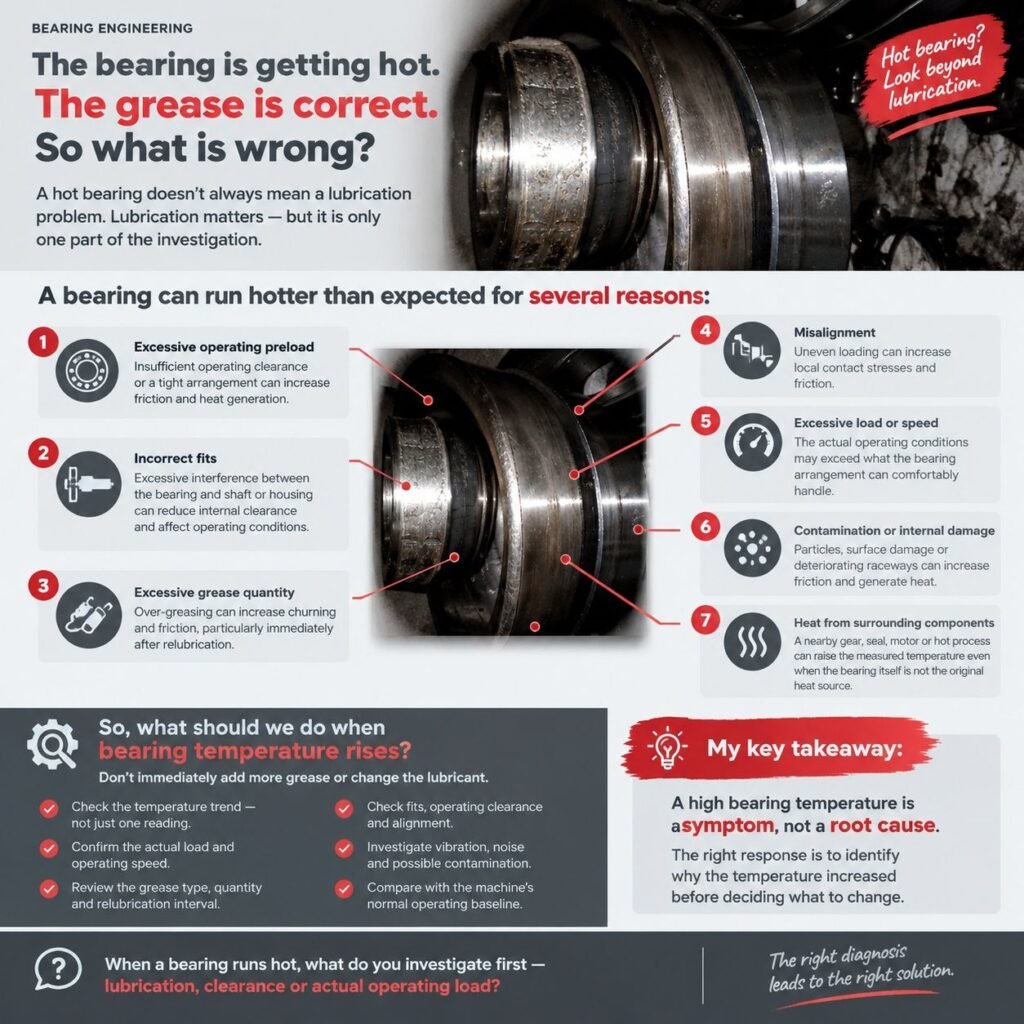

Lubrication matters—but it is only one part of the investigation.
A bearing can run hotter than expected for several reasons:
1. Excessive operating preload
Insufficient operating clearance or an excessively tight arrangement can increase friction and heat generation.
2. Incorrect fits
Excessive interference between the bearing and shaft or housing can reduce internal clearance and affect operating conditions.
3. Excessive grease quantity
Over-greasing can increase churning and friction, particularly immediately after relubrication.
4. Misalignment
Uneven loading can increase local contact stresses and friction.
5. Excessive load or speed
The actual operating conditions may exceed what the bearing arrangement can comfortably handle.
6. Contamination or internal damage
Particles, surface damage or deteriorating raceways can increase friction and generate heat.
7. Heat from surrounding components
A nearby gear, seal, motor or hot process can raise the measured bearing temperature even when the bearing itself is not the original heat source.
So, what should we do when bearing temperature rises?
Don’t immediately add more grease or change the lubricant.
Instead:
~Check the temperature trend—not just one reading.
~Confirm the actual load and operating speed.
~Review the grease type, quantity and relubrication interval.
~Check fits, operating clearance and alignment.
~Investigate vibration, noise and possible contamination.
~Compare the temperature with the machines normal operating baseline.
My key takeaway:
A high bearing temperature is a symptom, not a root cause.
The right response is to identify why the temperature increased before deciding what to change.
Question for maintenance professionals:
When a bearing runs hot, what do you investigate first—lubrication, clearance, or actual operating load?
