
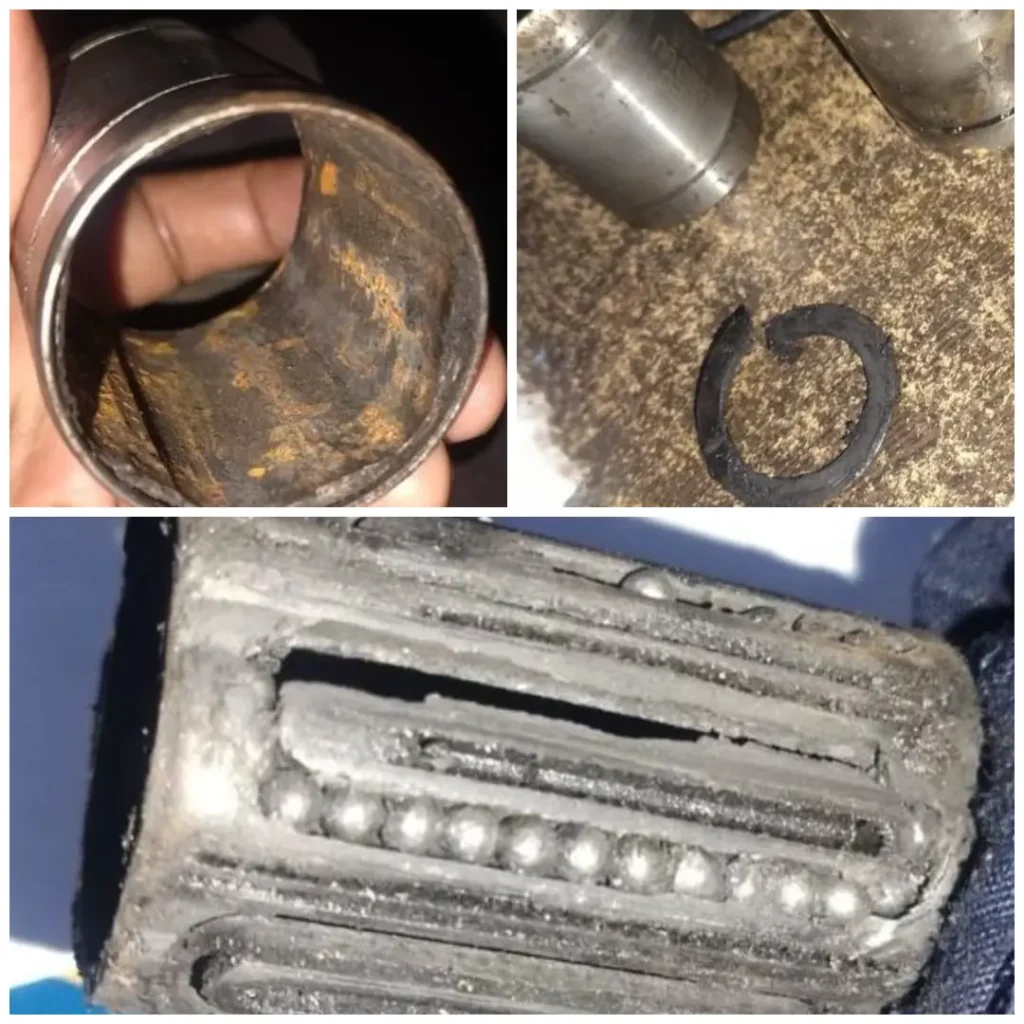
A bearing failed after just 1 day.
The first question should NOT be: “Why was the bearing bad?”
Recently, I came across a bearing used in a steel mill coil manufacturing application that had a running time of only 1 day.
When a bearing fails this quickly, it is tempting to blame the bearing immediately.
But a proper failure investigation should start with the entire bearing system.
A premature failure can be related to:
-> Incorrect mounting — excessive force, wrong fit, improper seating
-> Incorrect clearance — too much or too little operating clearance
-> Misalignment — shaft, housing or bearing-seat geometry
-> Lubrication problems — wrong grease, insufficient/excessive quantity or degraded lubricant
-> Contamination — dust, metal particles, water or other foreign material
-> Overload or shock load — operating conditions beyond the intended application
-> Seal failure — allowing contaminants or moisture to enter
-> Electrical damage — particularly in electrically driven equipment
We note that bearing damage should be classified systematically, because lubrication, contamination, mounting and application conditions can all contribute to premature damage.
Major bearing manufacturers also emphasizes that the cause of bearing damage does not necessarily lie in the bearing itself; the bearing, mating components, lubrication and sealing system have to be considered together.
My rule for failure analysis:
Don’t start with “Which bearing failed?”
Start with:
“What changed in the bearing’s operating environment?”
Check the bearing → shaft → housing → fit → clearance → lubrication → sealing → load → speed → alignment → operating conditions.
Because a 1-day failure is not automatically evidence of a bearing-quality problem.
Sometimes the failed bearing is simply the messenger of a problem somewhere else in the machine.
What is the first thing you check when a bearing fails within a few days of installation?

Source: Viradia Mehul, Director, KEC Bearings Pvt. Ltd.
Originally published on LinkedIn
Date: 30 September 2026
Republished with the author’s permission.