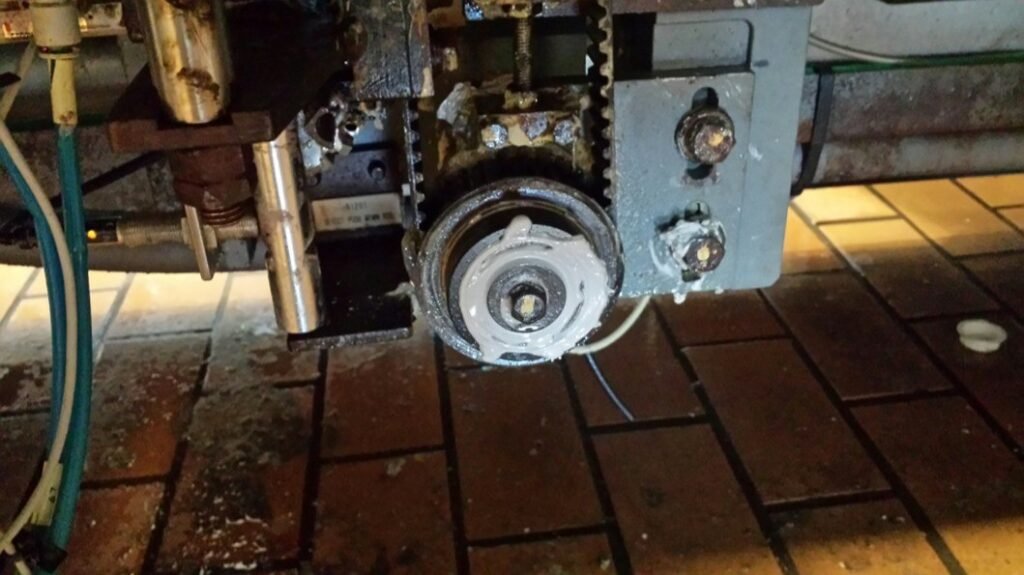

Industrial-grade lubricants running on equipment that touches your food.
Not because plant managers don’t care. But because most don’t know there’s a better, safer, and now necessary alternative.
Here’s why food-grade lubricants are no longer optional — they’re a business imperative.
The Hidden Risk on Your Production Floor
Every food processing plant runs machinery — conveyors, compressors, mixers, fillers, packaging lines, ovens, fryers, cold-chain systems. Every machine has bearings, gears, chains, and hydraulic systems. Every one of those needs’ lubrication.
Here’s the problem: conventional industrial lubricants contain additives, heavy metals, and mineral oil aromatic hydrocarbons (MOAH) that are classified as potential health hazards. When these lubricants leak, drip, or come into incidental contact with food — and in a 24/7 production environment, they eventually will — the food is contaminated.
The contamination may be invisible. The consequences are not.
A single contamination event can trigger product recalls, FSSAI penalties, loss of export certifications, and irreparable brand damage. For companies targeting international markets, non-compliance with global food safety standards is a deal breaker.
What Exactly Are Food-Grade Lubricants?
Food-grade lubricants are specially formulated products registered and certified for use in food processing environments. They are classified by NSF International into three categories:
NSF H1 — For use where incidental food contact may occur. Made from approved base oils and additives per FDA 21 CFR 178.3570, with an incidental contact limit of 10 parts per million. These are the most critical.
NSF H2 — For use on equipment where no food contact is possible. Compositional restrictions apply — no antimony, arsenic, cadmium, lead, mercury, or selenium.
NSF H3 — Edible oils used as rust preventives on hooks, trolleys, and similar equipment.
Additionally, ISO 21469 provides a comprehensive hygiene certification standard covering manufacturing practices, on-site audits, and product testing beyond what NSF H1 alone requires.
The bottom line: food-grade lubricants deliver the same technical performance — wear protection, corrosion resistance, thermal stability, load-carrying capacity — without the contamination risk.
Why India’s Diverse Food Processing Sector Needs This Now
India’s food processing landscape is uniquely diverse. Consider just a few sub-segments and their lubrication challenges:
Dairy Processing — High-moisture environments. Steam exposure. CIP washdowns that strip conventional lubricants. Bearings in pasteurizers, homogenizers, and filling machines need lubricants that resist water washout while remaining food-safe.
Edible Oil & Fats — High-temperature processing. Oil splashing creates contamination risk at every lubrication point. Conventional greases mix with the product and go undetected.
Bakery & Confectionery — Oven chains running at 200°C+. Dough mixers under extreme load. Conveyor systems moving sticky products. These need food-grade chain oils and greases that perform under thermal stress without carbonizing.
Snack & Namkeen Manufacturing — Fryers, extruders, seasoning drums. Every surface is a potential contact point. High-speed packaging lines where lubricant drip goes directly onto the product if not food-grade.
Meat, Poultry & Seafood — Cold-chain processing at sub-zero temperatures. High-humidity environments. Equipment must be washdown-compatible. Conventional lubricants fail in these conditions AND pose contamination risk.
Spice Processing — Grinding, mixing, and packaging in dusty environments. Lubricant contamination is nearly impossible to detect in coloured, flavored products.
Beverage & Juice Processing — High-speed filling lines. Acidic product exposure. Cap-seaming machines and conveyor chains need lubricants that resist both acid attack and incidental contact.
Potato & Vegetable Processing — Washing, peeling, cutting, frying, and freezing lines. Water, heat, and cold in the same plant. Every transition point is a contamination risk.
Each of these sub-segments operates different equipment under different conditions — but they all share one common reality: lubricant contamination is a when, not an if.
The Compliance Landscape Is Tightening
FSSAI is progressively strengthening India’s food safety framework. Global export markets — the EU, US, Japan, Middle East — already demand HACCP compliance, and HACCP explicitly requires that lubricants used in food zones be food-grade.
Global audit standards like BRCGS, FSSC 22000, and SQF now specifically evaluate lubricant management during plant audits. Plants using non-food-grade lubricants in food zones risk audit failures.
Export buyers from Europe, the US, and the Middle East increasingly require documented evidence that food-grade lubricants are used throughout the production chain. This is no longer a suggestion — it’s a qualifying criterion.
FSSAI’s regulatory trajectory is moving toward greater alignment with international food safety norms. Companies that proactively adopt food-grade lubrication now will be ahead of the curve when these become mandatory requirements.
The Real Cost Is NOT Switching
I often hear this from plant managers: “Food-grade lubricants cost more than regular industrial lubricants. Why should I switch?”
Here’s the reframing:
The cost of food-grade lubricants is not a line item in your maintenance budget. It is a line item in your risk management budget.
Consider the total cost of NOT switching:
→ Product recall costs: A single contamination-triggered recall can cost crores in product destruction, logistics, and regulatory penalties.
→ Brand damage: In the age of social media, a food safety incident becomes national news in hours. Brand recovery takes years.
→ Lost export opportunities: Without food-grade lubrication compliance, you cannot pass international food safety audits. Every failed audit is a closed market.
→ Audit failures: BRCGS, FSSC 22000, and SQF auditors specifically check lubrication practices. Non-compliance jeopardizes your certifications.
→ Insurance and liability: Food contamination events create significant legal liability that insurance may not fully cover.
When you calculate the total cost of risk, food-grade lubricants are not more expensive. They are significantly cheaper than the alternative.
Five Steps Every Food Processor Should Take Today
1. Audit your lubrication points. Map every piece of equipment. Identify where lubricant is used and classify each point as H1-zone (incidental food contact possible) or H2-zone (no contact possible). Most plants discover they have far more H1 zones than they assumed.
2. Start with the critical points. You don’t need to convert the entire plant overnight. Begin with the highest-risk equipment — conveyors, fillers, mixers, packaging machines, and any equipment directly above or adjacent to open food product.
3. Choose certified products. Insist on NSF H1 registration for all H1-zone lubricants. Verify registrations on the NSF White Book database. Ask your lubricant supplier for certification documentation — not just claims.
4. Work with a lubrication specialist, not just a supplier. The right partner will conduct a plant lubrication audit, recommend the correct food-grade product for each application, define the right quantity and re-lubrication intervals, and provide ongoing condition monitoring. This is not a transactional purchase — it is a technical partnership.
5. Document everything. Maintain records of which food-grade lubricants are used where, when re-lubrication was done, and by whom. This documentation is critical for HACCP compliance and audit readiness.
The Opportunity for India
India’s food processing sector is at an inflection point. The sector is projected to more than double from $307 billion in 2023 to $700 billion by 2030. Government initiatives like PMKSY and PLI schemes are driving massive capacity expansion. New plants are being commissioned across the country.
Every new plant is an opportunity to set the right lubrication standard from Day 1.
And for existing plants — the transition to food-grade lubricants is not just about compliance. It’s about demonstrating to your customers, your auditors, and your consumers that food safety is non-negotiable.
The plants that make this transition now will lead. The rest will follow — or fall behind.
What has been your experience with food-grade lubricants in food processing? Are you seeing increased demand for compliance from your buyers and auditors? I’d love to hear your perspective.
#FoodGradeLubricants #FoodSafety #FoodProcessing #FSSAI #NSF #HACCP #LubricationEngineering #Dairy #Bakery #Beverages #SpecialtyLubricants #MaintenanceExcellence #yellowdrums #BECHEM