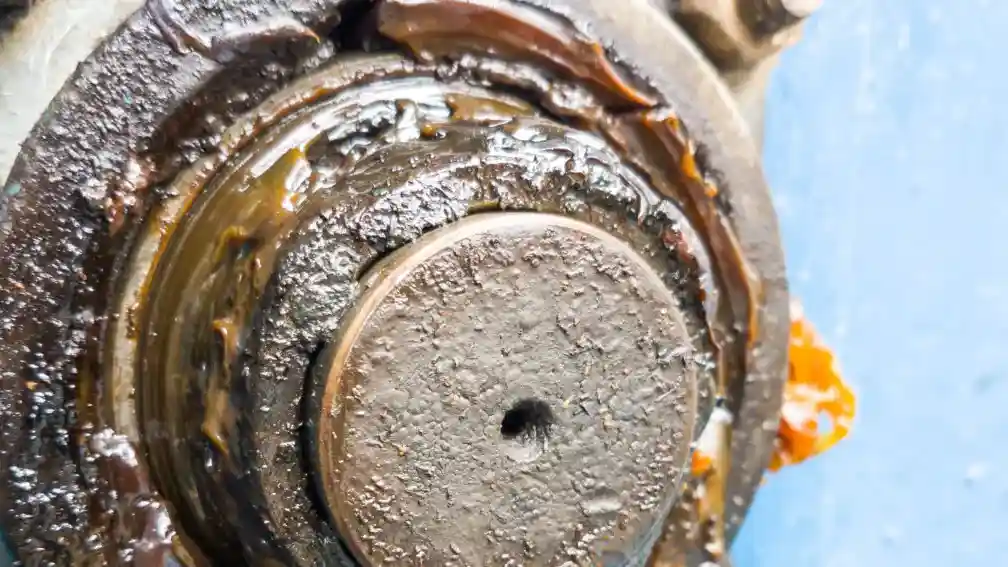

Here’s what actually happens when you over-lubricate a bearing:
❌ Churning & internal friction — Excess grease has nowhere to go. It gets forced between the rolling elements and races, creating hydraulic resistance. The bearing has to work harder just to rotate, consuming more energy and generating heat that was never supposed to be there.
❌ Temperature spikes of 5–15°C — That may sound minor, but in bearing life calculations, every 10°C rise above optimal operating temperature can cut lubricant service life in half. You’re accelerating degradation with the very product meant to prevent it.
❌ Seal damage & contaminant ingress — Overpressurized grease pushes against seals and shields, deforming or displacing them. Once seal integrity is compromised, you’ve opened the door to moisture, dust, and particulate contamination — the very things lubrication is supposed to guard against.
❌ Premature wear & shortened bearing life — The combined effect of excess heat, increased friction, and compromised seals means bearings that should last 5–8 years are failing in 2–3. Sometimes sooner.
❌ Wasted product + wasted labor — Every unnecessary gram of grease is money pumped directly into the waste stream. Multiply that across hundreds of grease points on a plant floor, and the annual cost is staggering.
📊 Real Data from Multiple Industries:
These aren’t theoretical scenarios. Here are documented results from actual lubrication optimization projects:
🔩 Rolling Mill Stands:
- Before: 3 barrels/month consumed, re-greasing required every 24 hours, frequent unplanned downtime for bearing replacements
- After: Optimized grease quantity paired with Bechem Premium 2 (a high-performance lithium complex grease engineered for heavy loads and elevated temperatures)
- Result: 45% reduction in grease consumption, re-greasing intervals extended to 40+ hours, measurable reduction in bearing operating temperatures, and fewer unplanned shutdowns
🔩 Continuous Casting Machines (Bonus Case):
- Before: Multipurpose grease applied generously across all positions, segment roller bearings replaced frequently
- After: Application-specific grease selection based on load, speed, temperature, and water exposure at each position
- Result: Extended bearing service life by 2x, reduced grease usage by 35%, and significantly lower disposal costs
The pattern across all these cases is identical: less grease, better grease, applied correctly = superior results.
🎯 The Right Approach — A Framework for Every Plant:
1️⃣ Calculate bearing free volume Every bearing has a defined internal free space. Best practice for most applications is 30–50% fill at initial packing. Overfilling beyond this creates the churning effect described above. Your bearing manufacturer’s catalog provides the dimensions you need for this calculation.
2️⃣ Determine correct top-up quantity based on speed factor (N×Dm) The speed factor (shaft RPM × bearing mean diameter in mm) dictates how much grease a bearing can tolerate during re-lubrication. Higher speed factors demand smaller, more frequent doses. The commonly used formula — G = 0.005 × D × B (where D is the bearing outside diameter and B is the bearing width, both in mm) — gives a reliable starting point in grams per re-lubrication event.
3️⃣ Monitor temperature & vibration regularly Trending bearing temperature and vibration signatures is your early warning system. A sudden spike in either parameter after re-greasing is a strong indicator of over-lubrication. Condition monitoring should inform your lubrication intervals — not the calendar alone.
4️⃣ Choose application-specific grease — not “multipurpose” “Multipurpose” grease is a compromise everywhere and optimized nowhere. Factors to evaluate include base oil viscosity, thickener type (lithium complex, polyurea, calcium sulfonate, etc.), operating temperature range, load-carrying capacity (EP additives), water resistance, and compatibility with existing grease in the system. The wrong grease in the right quantity still leads to failure.
5️⃣ Train your maintenance teams The best lubrication program in the world fails at the grease gun. Technicians need to understand why they’re applying a specific quantity at a specific interval — not just follow a task card. When the person holding the grease gun understands bearing physics, everything changes.
💡 Key Takeaway:
Application engineering isn’t just technical — it’s financial and environmental. Every barrel of grease you don’t waste is money saved, disposal avoided, and environmental impact reduced. Every bearing that reaches its design life instead of failing early is production preserved and capital expenditure deferred.
The ROI on a proper lubrication audit is typically measured in weeks, not years.
📌 Question for maintenance professionals: Are you calculating your grease quantities using engineering data, or are you still following “tradition” — pumping until you see it squeeze out the seal?
If it’s the latter, you’re not protecting your equipment. You’re shortening its life and inflating your maintenance budget at the same time.
I’d love to hear your experiences. Drop your before/after stories in the comments. 👇